Shortly after starting my research position at the Medical Museion (University of Copenhagen), I became really intrigued by how museum staff worked with the human remains in our care. Not only by how they are displayed, curated and described in our museum’s exhibit halls, but also by how we extend (or…not extend) our care to their data. I was surprised to find out that there isn’t a whole lot of research on the subject of data work with human remains. We know that these bodies were collected mostly from vulnerable or marginalized social groups, often with no consent - and their historical classification is often marked by ableist and racist categories. These are some examples of the issues that contemporary museum staff - and the staff of many university-based collections of human remains - have to deal with when creating and maintaining databases of human remains.
So I set out to find out how people working in museums and scientific collections practically deal with these issues - the result is documented in the scientific article “Digitizing the Dead: Understanding ‘Data Haunting’ to Support Equitable Data Work with Human Remains”, which was presented at the ACM CHI 26 Conference on Human Factors in Computing Systems. It was a fun project to work on, together with colleagues Adam Bencard and Luigina Ciolfi.
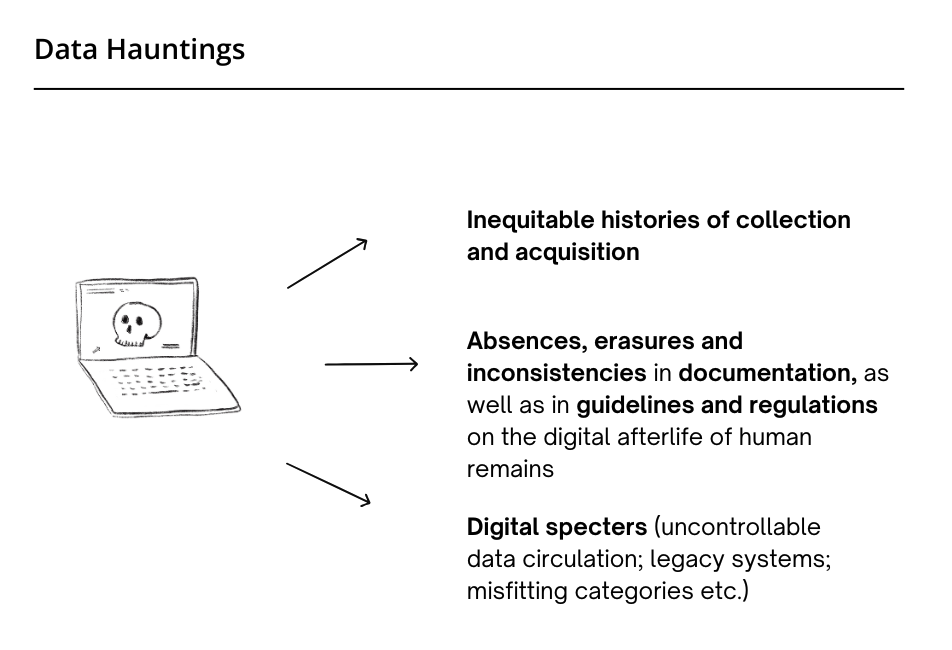
Diagram by Valeria Borsotti
In this article we document the many ‘data hauntings’ that are lingering in databases of human remains - historical, regulatory and technical, and reflect on the uncertainties of working with future data circulation related to these sensitive assets. Based on the empirical data collected, we propose a framework to create and support more equitable sociotechnical systems for working with human remains.
If you are interested, you can read more here, is open access! https://dl.acm.org/doi/full/10.1145/3772318.3791791
I am also on Medium, where you can follow my blog posts more easily: https://medium.com/@valeria.borsotti